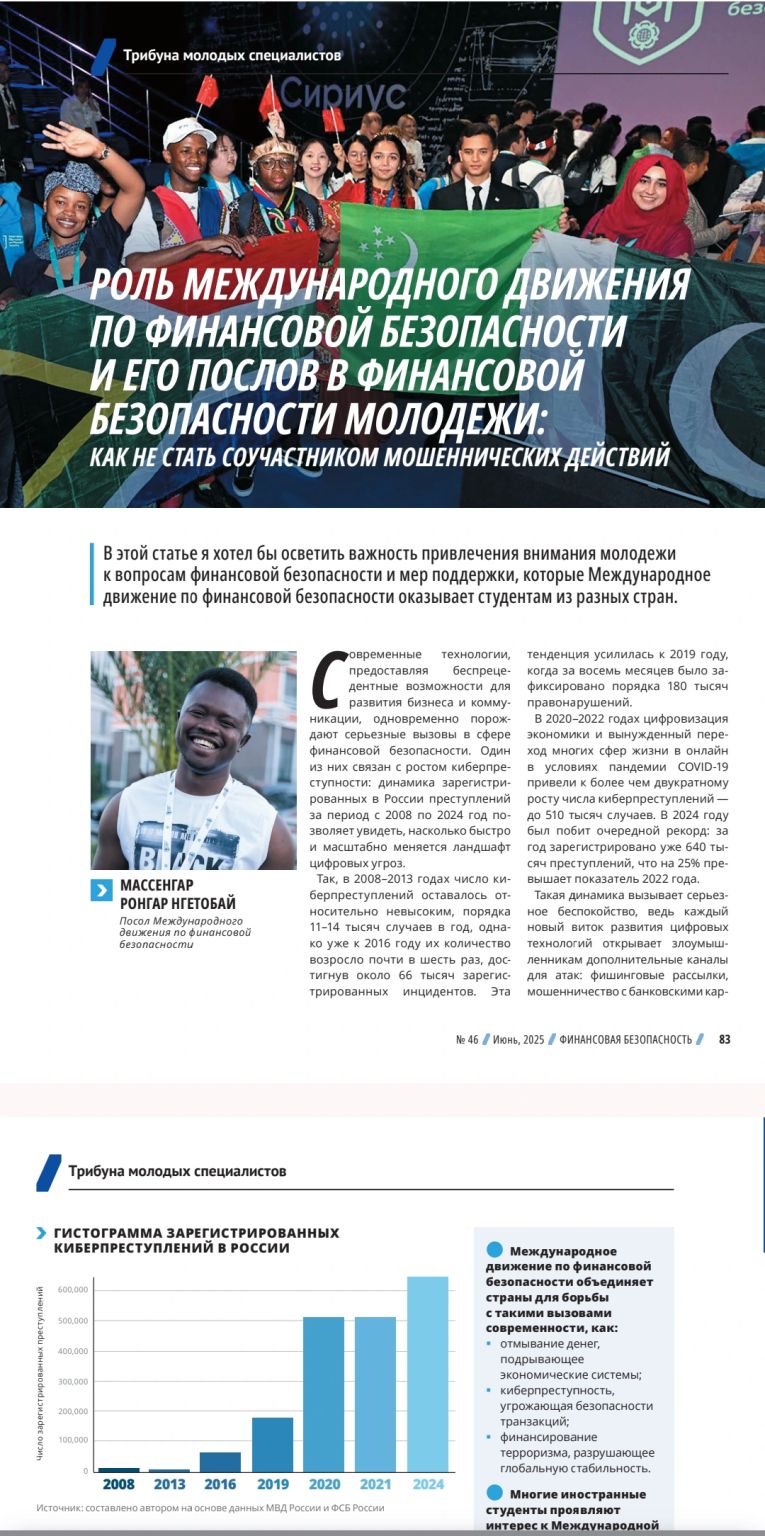
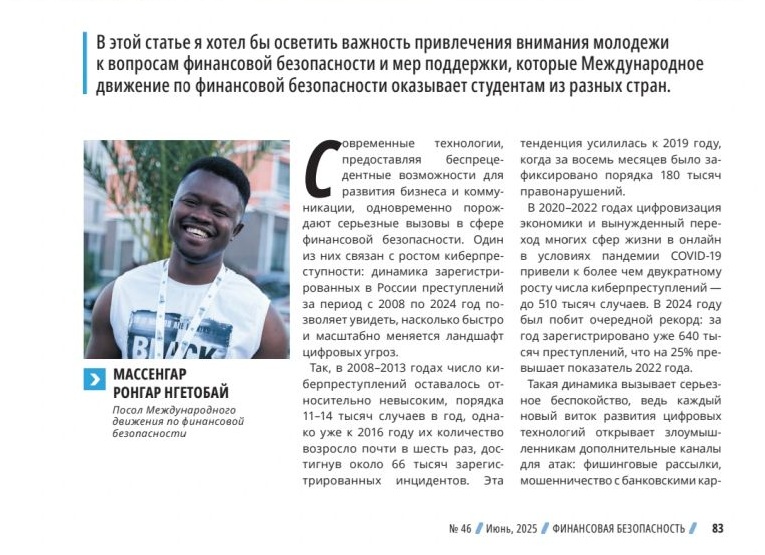
I have the honor of contributing to the journal of Rosfinmonitoring of Russia. This collaboration with the Federal Financial Monitoring Service of the Russian Federation represents one of the most rewarding aspects of my professional work. Rosfinmonitoring, as the national institution responsible for combating money laundering, terrorist financing, and the proliferation of weapons of mass destruction, plays a crucial role in preserving the integrity of the Russian financial system and protecting national economic security.
My contributions to this prestigious institution's official journal allow me to share my analyses, field experiences, and perspectives on financial security challenges with an audience of financial sector professionals, regulators, law enforcement, and policymakers. The articles I write cover a wide range of topics, including emerging trends in financial crime, specific financial security challenges in developing countries, international best practices for preventing money laundering, and technological innovations in detecting and preventing illicit financial activities.
This platform also enables me to highlight the international dimensions of financial security, particularly the challenges faced by African countries in combating illicit financial flows, corruption, and tax evasion. Drawing on my experience working with authorities and financial institutions in numerous African countries, I can offer unique perspectives on these issues and contribute to a better understanding of on-the-ground realities that are often absent from purely theoretical analyses or those based solely on developed countries' experiences.
As the International Ambassador for Financial Security, I organize International Olympiads covering finance, mathematics, information technology, and other fields. This ambassadorial role, conferred upon me in recognition of my commitment to financial education and the promotion of financial security on an international scale, is a responsibility I take very seriously and a mission to which I am passionately dedicated.
The International Olympiads I organize represent far more than a mere academic competition. They constitute a holistic education and awareness program designed to equip young people worldwide with the knowledge, skills, and attitudes necessary to navigate safely in the increasingly complex financial landscape of the 21st century. These olympiads align with a long-term vision to create a generation of financially literate citizens capable of protecting their own economic interests while contributing to the stability and integrity of their countries' financial systems.
The format of the International Olympiads is designed to be both rigorous and engaging. Participants, typically secondary school and early university students, are evaluated across several complementary disciplines. The financial component tests their understanding of fundamental economic concepts, financial products, markets, institutions, and above all, the risks and frauds to which financial consumers are exposed. This section goes beyond mere financial theory to incorporate real-world case studies, fraud situation simulations, and practical financial decision-making exercises.
The mathematical component of the olympiads recognizes that financial literacy rests on a solid foundation of quantitative skills. Participants are tested on their ability to perform financial calculations, understand and interpret statistical data, assess probabilities and risks, and use mathematical models to analyze complex financial situations. This mathematical dimension is essential because many financial frauds exploit precisely the lack of quantitative understanding among potential victims.
The information technology component reflects the rapid digital transformation of the financial sector and the emergence of new technology-based forms of financial crime. Participants are evaluated on their understanding of cybersecurity, personal data protection, cryptocurrencies and blockchain technology, digital payment systems, and techniques used by cybercriminals to compromise financial systems and steal funds. This component also includes practical exercises in detecting phishing attempts, identifying fraudulent websites, and securing online transactions.
Beyond these three main pillars, the olympiads incorporate elements from other relevant fields. Sessions on financial ethics explore the moral dilemmas that finance professionals may face and foster a culture of integrity. Modules on financial law and regulation provide a basic understanding of the legal framework governing financial activities and protecting consumers. Presentations on behavioral economics help participants understand cognitive biases that can affect their financial decisions and make them vulnerable to manipulation.
We also train young people to protect their financial assets by developing their financial literacy. This training goes well beyond preparation for the olympiads themselves. We have developed a comprehensive financial education program deployed in schools, universities, and youth organizations in participating countries. This program systematically addresses the essential financial skills that every young person should possess before entering adulthood.
The training modules cover personal and family budgeting, teaching young people how to track their income and expenses, set financial priorities, and live within their means. We address saving and investing, explaining the importance of building an emergency fund, basic investment principles, and the various savings and investment vehicles available. The training also includes sessions on credit and debt, helping young people understand how credit cards, student loans, mortgages work, and how to avoid over-indebtedness.
Special attention is given to recognizing and preventing financial frauds. Young people learn to identify warning signs of Ponzi schemes, pyramid schemes, investment scams, romance frauds, phishing scams, and countless other stratagems criminals use to separate people from their money. We use real-world case studies, victim testimonials, and role-playing exercises to make these lessons concrete and memorable.
The training also addresses identity protection and personal information security in the digital age. Young people learn the importance of creating strong, unique passwords, using two-factor authentication, recognizing phishing attempts, securing their devices, and protecting personal information on social media. In a world where data breaches are commonplace and identity theft can have devastating consequences, these skills are essential.
We also teach young people their rights as financial consumers and the recourse mechanisms available when they are victims of abusive or fraudulent practices. This includes understanding consumer protection laws, knowing financial regulatory authorities and their roles, and complaint and mediation processes. This dimension of active financial citizenship training is crucial for creating a culture where financial abuses are reported and combated rather than accepted as inevitable.
Last year, 36 countries worldwide participated; this year, we hope to exceed that number. The previous edition of the International Olympiads was a remarkable success, with participation spanning all continents. The 36 participating countries included nations from all regions: several African countries including Chad, Mali, Senegal, the Central African Republic, Nigeria, Kenya, and South Africa; Asian countries such as India, China, Kazakhstan, Uzbekistan, and Vietnam; Latin American nations including Brazil, Mexico, and Argentina; Middle Eastern countries like Egypt and the United Arab Emirates; and of course Russia as the main host country.
This geographical diversity created a truly international environment where young people from different cultures, economic systems, and development levels could interact, share experiences, and learn from one another. Exchanges between participants often revealed that, despite contextual differences, young people worldwide face similar financial security challenges and benefit from learning strategies developed in other countries to address them.
Last year's edition mobilized tens of thousands of young people through national selection rounds, with thousands reaching regional stages, and ultimately hundreds of elite students participating in the international final. Participants' performances were impressive, demonstrating a high level of financial understanding, analytical skills, and commitment to financial security principles.
The closing ceremony of the previous edition, held in Moscow with the participation of high-ranking Russian government officials, representatives of international organizations, and ambassadors from many participating countries, was a moment of celebration for academic excellence and commitment to global financial security. Winners received not only symbolic awards and scholarships but also internship opportunities in prestigious financial institutions, invitations to international conferences, and access to a growing alumni network.
For this year's edition, we have set ambitious goals to exceed participation from 36 countries. We are currently conducting an active outreach campaign with ministries of education, central banks, financial regulators, and youth organizations in many countries that did not participate in the previous edition. Our goal is to reach 50 participating countries, making this the largest and most inclusive edition to date.
We are working particularly to increase participation from African countries, recognizing that the continent faces particularly acute financial security and financial inclusion challenges, and that educating young people represents a crucial investment in the continent's economic future. I am actively using my professional networks and relationships with African authorities to promote the olympiads and facilitate participation from new African countries.
We are also seeking to strengthen participation from Central American and Caribbean countries, Southeast Asian regions, and some European countries that have not yet joined this initiative. To encourage this expansion, we have developed training resources in multiple languages, created technical assistance programs to help countries organize their national selection rounds, and established partnerships with international organizations that can provide financial and logistical support to resource-limited countries.
The expansion of the olympiads is accompanied by enrichment of the content and format. This year, we are introducing new components including financial crisis simulations where teams must collaborate to manage economic emergency situations, fintech app development competitions that combine technical skills and financial understanding, and debates on contemporary financial ethics issues that develop critical thinking and argumentative skills.
We are also expanding the training program associated with the olympiads. Beyond direct competition participants, we aim to reach hundreds of thousands of young people through online learning platforms, webinars, educational videos, and downloadable resources that teachers and educators can use in their own contexts. This cascading approach aims to maximize the initiative's impact and reach young people who may not participate in the competitive olympiades but would nevertheless benefit from financial security education.
A particularly innovative aspect of our approach is the integration of professional mentors into the program. We recruit bankers, financial regulators, cybersecurity experts, economists, and other professionals who agree to serve as mentors to young participants. These mentors provide advice, share professional experiences, and help young people understand the practical applications of the concepts they learn and career opportunities in the financial security sector.
The mentoring program also offers a professional development dimension for the highest-performing young participants. Those who excel in the olympiads receive personalized guidance to plan their educational and professional trajectories, with a particular focus on developing careers in fields related to finance, technology, regulation, or combating financial crime. Several alumni from previous editions are now pursuing higher education in finance or economics, and some have already begun promising careers in the financial sector.
The impact of the International Olympiads extends beyond the individual skills acquired by participants. The program also contributes to raising the general level of financial literacy in participating countries, raising policymakers' awareness of the importance of financial education, and catalyzing the development of national financial education policies and programs. In several countries, participation in the olympiads has directly led to the integration of financial education into national school curricula and the allocation of government resources to this priority.
The program also creates a growing international network of young leaders aware of financial security issues and committed to financial integrity. This network transcends national borders and creates connections between young people who, in their future careers, could become key actors in international financial security cooperation. Olympiad alumni remain connected through an online platform, participate in annual meetings, and collaborate on joint projects.
As the main organizer of this initiative, I am deeply proud of what we have accomplished and enthusiastic about the possibilities the future holds. Every young person we train, every fraud we help prevent, every financial security career we inspire represents a tangible contribution to building a safer, more transparent, and more inclusive global financial system.
The International Financial Security Olympiads embody my deep conviction that investing in youth education is the most effective and sustainable strategy for combating financial crime and promoting economic stability. As we prepare this year's edition with the ambition to exceed last year's 36 countries, I am driven by the vision of a future where every young person, regardless of their country of origin or socio-economic level, possesses the knowledge and skills needed to protect their financial assets, contribute to their community's prosperity, and actively participate in building a more just and secure global economic order.
This mission as Financial Security Ambassador is more than a title or professional function for me; it is a personal commitment to future generations and a contribution to a world where financial security is not a privilege reserved for a few, but a right accessible to all.
Financial Security Ambassador: My Commitment to Youth Financial Education
July 16, 2025
Gallery & Media