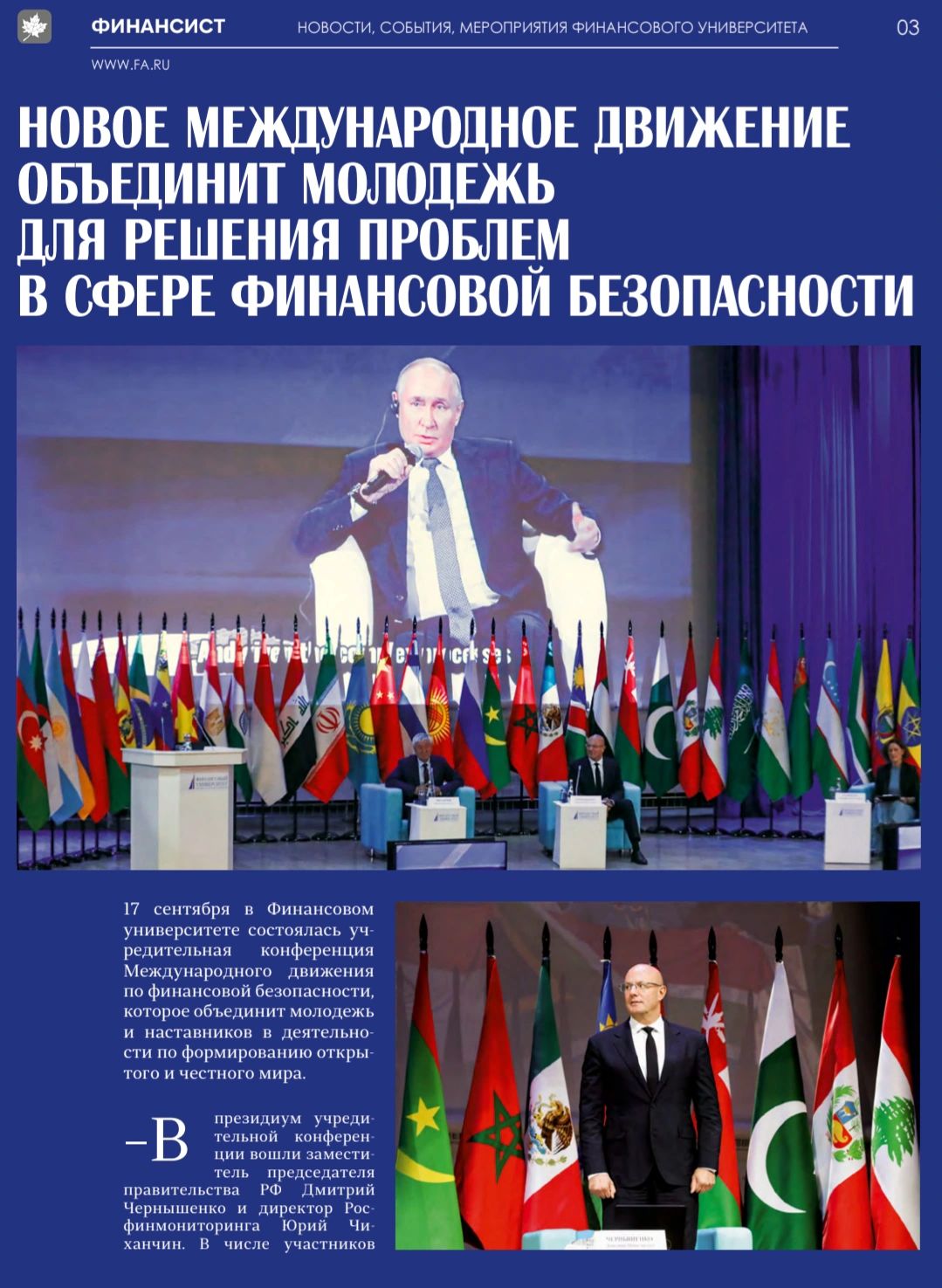
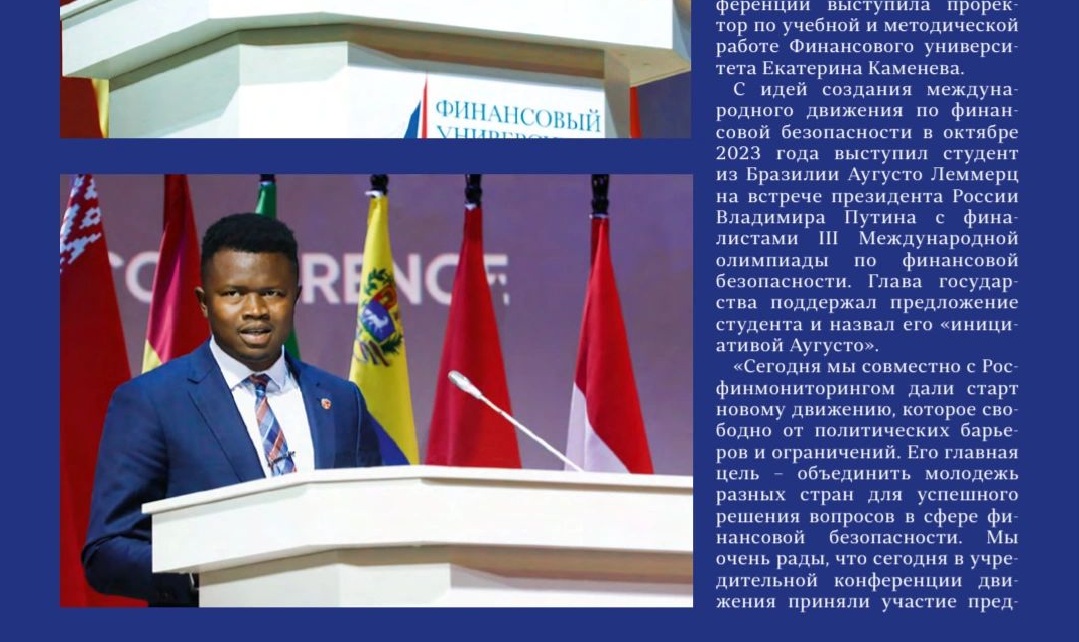
September 17: Under the high patronage of the President of the Russian Federation, Vladimir Putin, who had supported the initiative of Brazilian student Augusto Lemmerz, the constitutive conference of the International Movement for Financial Security was held on September 17 at the Financial University. This date marks the founding moment of a global initiative aimed at transforming the approach to global financial security by placing youth at the heart of this transformation.
A Student Initiative Turned Global Movement
The movement's origin in the initiative of Augusto Lemmerz, a Brazilian student at the Financial University of Moscow, perfectly illustrates its philosophy: young people are not simply passive beneficiaries of financial education but active actors and initiators of change. Augusto had observed the growing vulnerabilities of youth to financial and cyber threats and had conceptualized a movement that would mobilize global youth around these issues.
The presidential support conferred institutional legitimacy to the movement and facilitated the mobilization of substantial resources as well as the engagement of high-level government institutions.
Strategic Leadership
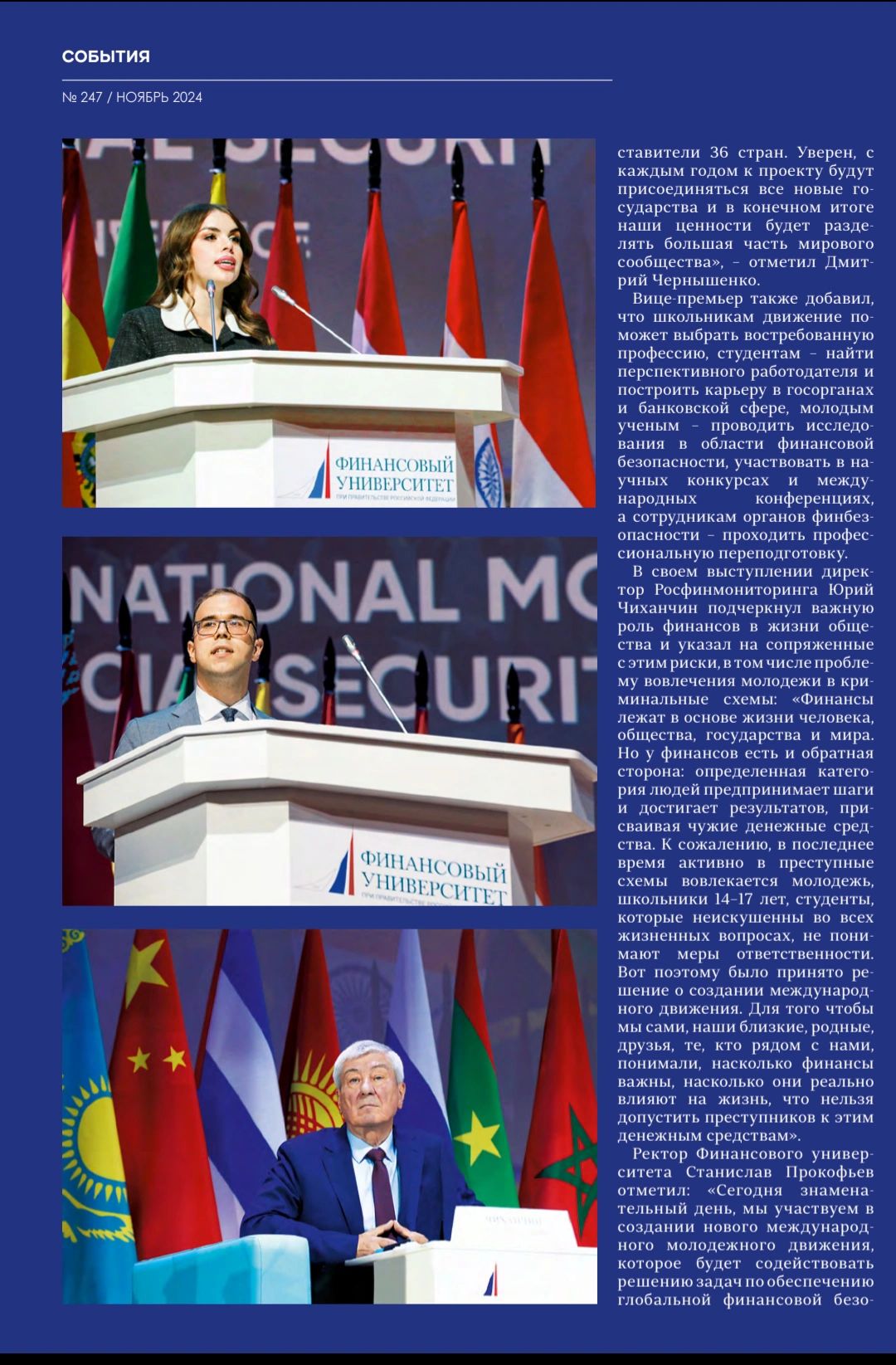
The key personalities elected to lead the movement include Dmitry Chernyshenko, Deputy Prime Minister of Russia as President of the Presidium; Yury Chikhanchin, Director of Rosfinmonitoring as Vice President; and Vladimir Ovchinnikov, Director of the International Network Institute as Executive Secretary.
This composition reflects the inter-institutional nature of the movement, combining high-level government representation, financial monitoring expertise, and international networking technical capabilities. Chernyshenko brings political weight and access to government resources. Chikhanchin provides the technical expertise of Rosfinmonitoring in anti-money laundering and counter-terrorist financing. Ovchinnikov ensures the operational coordination of this complex initiative involving dozens of countries.
Remarkable International Participation
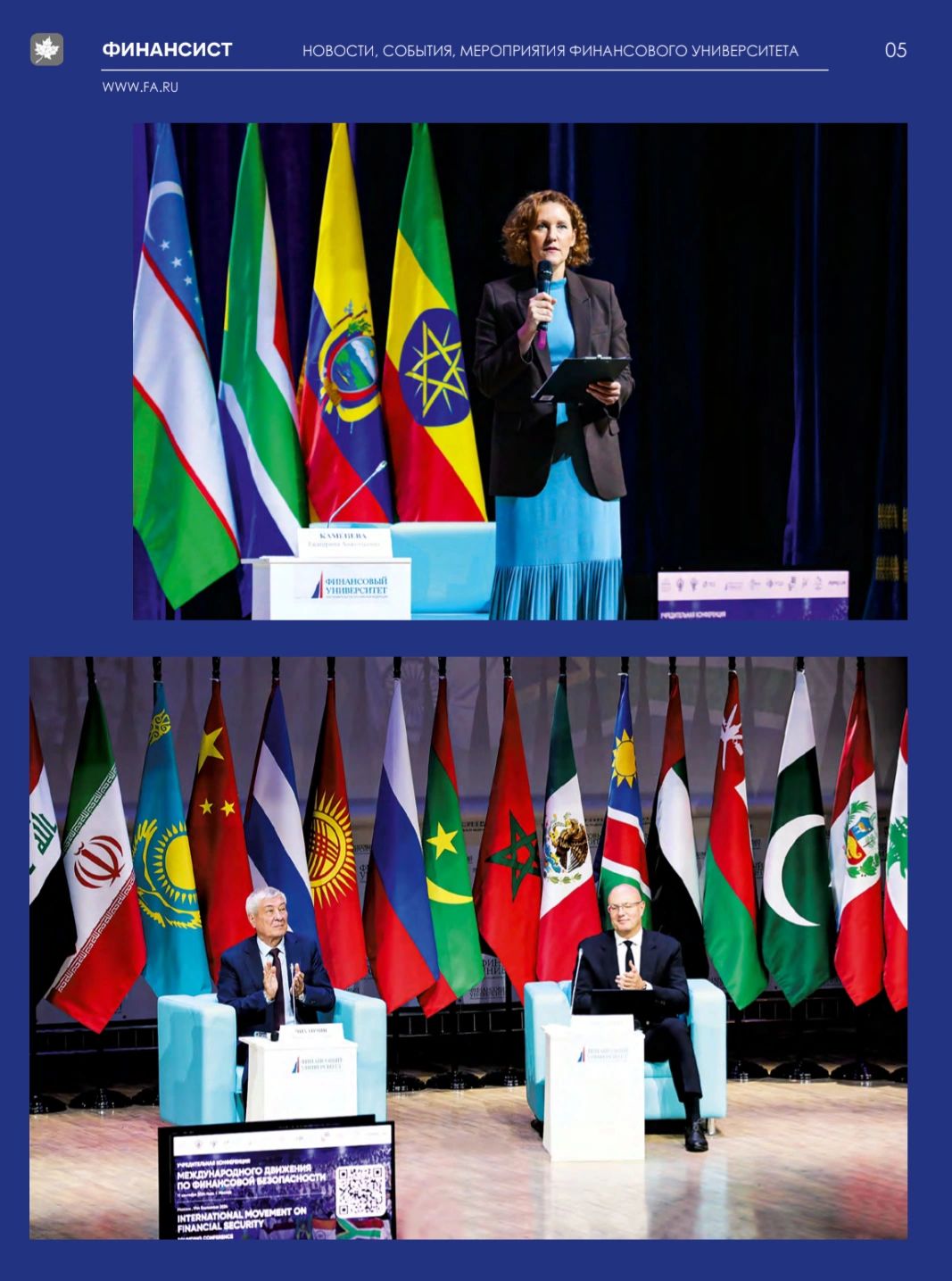
The event brought together participants from thirty-six countries and was moderated by Ekaterina Kameneva, Vice-Rector of the Financial University. This participation from the constitutive conference demonstrates the universal appeal of financial security as a common concern. The delegations present represented remarkable geographical diversity, including countries from Africa, Asia, Latin America, Europe, and the Middle East.
Each delegation was composed of students, university representatives, government officials, and sometimes embassy representatives. This mixed composition reflected the movement's holistic approach, recognizing that financial security education requires collaboration between academia, government authorities, and international institutions.
Three Strategic Objectives:
The strategic objectives of the movement are to unite global youth around the challenges of financial security, to promote a transparent and equitable financial system, and to support career guidance and academic research in this field.
Uniting global youth recognizes that the challenges are fundamentally global. Financial crime operates across borders, exploiting regulatory differences. The movement aims to create sustainable networks among young people from different countries, facilitating exchanges and building a global generation of financial security advocates.
Promoting a transparent and equitable financial system places the movement in a transformative perspective. It is not simply about adapting individuals to the existing system, but about cultivating a generation that will demand and contribute to creating fairer and more accountable financial systems.
Supporting career guidance and research recognizes that financial security is a rapidly developing professional field, offering substantial career opportunities. The movement connects students to educational opportunities, internships, and jobs in this sector, while encouraging research on emerging dimensions of financial security.
The Official Ambassadors
Among the official ambassadors of the movement are Nguetobaye Massengar Rongar of the Republic of Chad, a graduate student at the Financial University, and Ekaterina Bazanova, a student at the same university who performed the solemn reading of the constitutive declaration during the ceremony.
My election as an official ambassador represents one of the most significant honors of my professional life. As the first African ambassador of the movement, I represent not only Chad but the African continent as a whole. This position confers upon me the responsibility to ensure that the specific perspectives and challenges of African youth are fully taken into account.
Africa faces particular vulnerabilities: less developed financial systems, sometimes inadequate regulation, high rates of financial exclusion, prevalence of fraud. My role as ambassador allows me to serve as a model for other young Africans, demonstrating that a successful career is accessible through education and integrity rather than through fraudulent shortcuts.
Ekaterina Bazanova had the honor of solemnly reading the constitutive declaration. This symbolic moment, where a young woman proclaimed the founding principles before an assembly of high-level government officials and international delegations, embodied the movement's philosophy: giving voice and agency to youth.
The declaration articulated the fundamental values: financial integrity, transparency, fairness, education, international cooperation, accountability. It defined the ethical principles that will guide all activities and established the members' commitments to promoting financial security.
Technological Infrastructure and Symbol
The collaborative platform "Sodruzhestvo" (meaning "Community" in Russian) will serve as the technological base of the movement, while a process to select the official symbol is underway through a popular consultation open to all members.
"Sodruzhestvo" is a sophisticated digital platform offering several essential features: free educational resources (online courses, videos, case studies) in multiple languages; collaboration spaces for joint projects; organization of International Olympiads; discussion forums with experts and mentors; networking tools; a badge system rewarding contributions.
The infrastructure was designed to be accessible even with limited connectivity, recognizing that many members, particularly in Africa and Asia, may not have access to stable high-speed internet.
The process of selecting the official symbol, conducted through popular consultation, illustrates the movement's democratic approach. Hundreds of proposals were submitted, reflecting remarkable creative diversity—from traditional elements (scales, shields, padlocks) to contemporary motifs (interconnected networks, electronic circuits). Voting takes place on Sodruzhestvo with several elimination rounds, creating a sense of collective ownership.
Since September 17
In the months following the conference, the movement has experienced rapid growth. National sections have been established in most of the 36 participating countries, with national coordinators, advisory committees, and action plans. Several countries have organized their first national events.
Many countries not initially represented have since expressed interest, testifying to the movement's growing attractiveness. Negotiations are underway with more than twenty additional countries. This expansion validates that financial security represents a universal concern.
As an ambassador, I have intensified my efforts in Africa: presentations at international conferences, contacts with African ministries of education, collaboration with African universities, mobilizing youth for the Olympiads. My personal goal is to see at least fifteen African countries represented at the next Olympiads and to make Africa one of the most dynamic regions of the movement.
September 17 will remain engraved in my memory as the day I officially assumed the role of international ambassador for financial securitya role that gives deep meaning to my work and allows me to contribute to building a more secure financial future for young people worldwide, and particularly for those of my native continent, Africa.
September 17: Birth of the International Movement for Financial Security.
September 17, 2025
Gallery & Media